

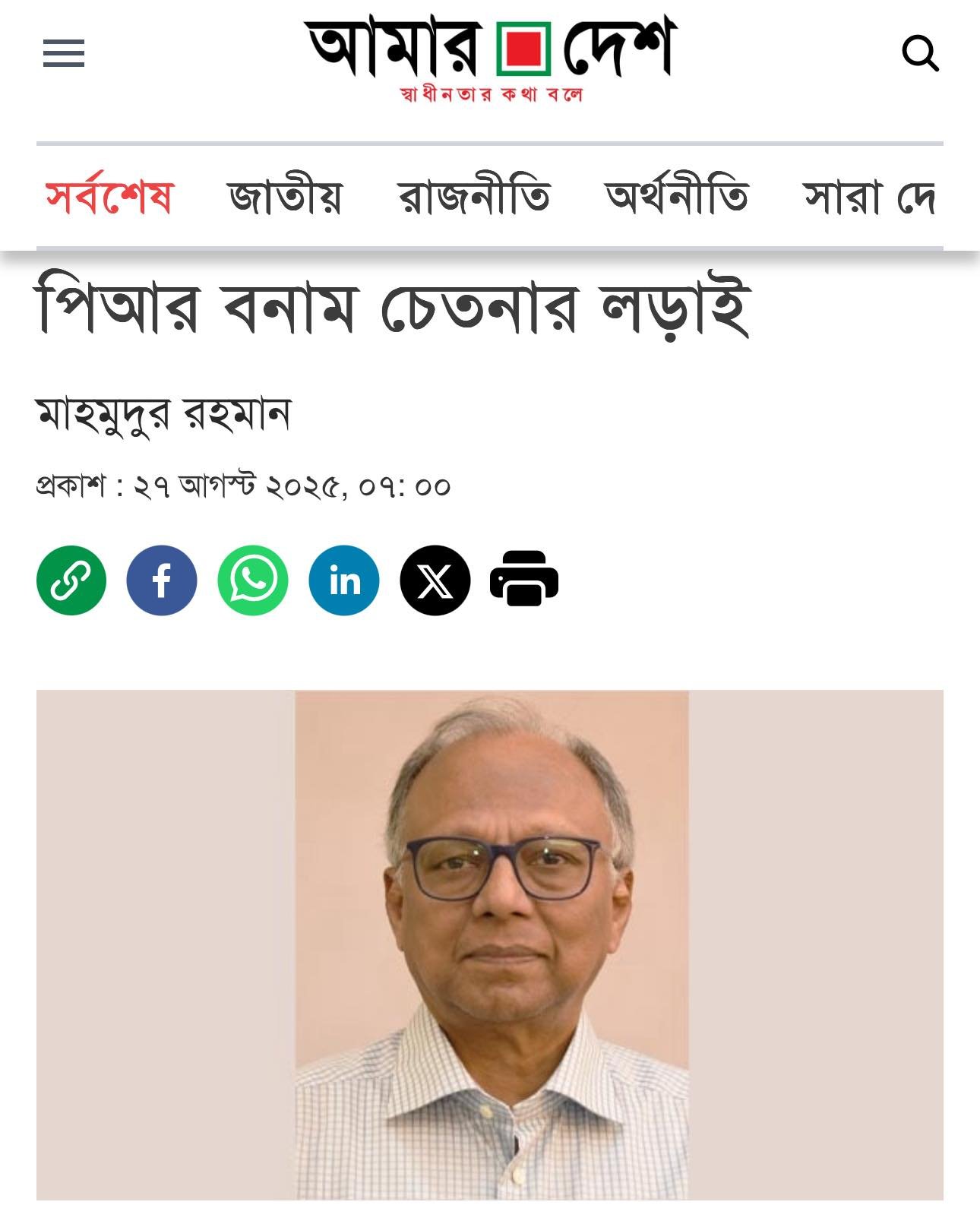
Reading today’s commentary report, I am fairly certain that all the major political parties in the country will be quite furious with me. However, I have reached a point in life where I no longer care about such anger or resentment. No matter how much our leaders talk about media freedom, they always prefer party-loyal creatures. If any newspaper publishes something outside their personal or party interests, they promptly label it as opposition-leaning. The main party, BNP, wants a “Dinkal” style newspaper, while the second major party, Jamaat, undoubtedly prefers “Sangram” at the top of their list. Within BNP, for quite some time, a peculiar transformation of political character has been underway. Once champions of “Bangladeshi nationalism,” they are now striving to become “Bengali nationalists,” desperately seeking the support of all identified progressive media and Islamophobic talk show stars. We are observing this astonishing evolution within the party with great interest. I believe figures like Fazlur Rahman, an advisor to the chairperson and an agent of Indian hegemonic ideology, are merely a visible symptom of BNP’s ideological decline. The real malaise, perhaps like an invisible cancer, has spread much deeper.
Anyway, let’s get to the main point.
In his latest address to the nation on August 5, the Chief Advisor announced a specific timeline for elections in early February and sent a formal letter to the Chief Election Commissioner to organize the elections, raising hopes that all political uncertainties would be resolved. With roughly five months left until the elections, political parties should have already been reaching out to the public with their respective agendas. However, instead of trying to win voters’ hearts, political leaders are emphasizing their contradictory, hateful, and rigid stances in their daily statements. This has left patriotic citizens anxious about the future, while the fugitive fascist Sheikh Hasina in Delhi, her blind supporters in Gopalganj and the Awami circle, and their Indian patrons are evidently delighted. They hope that this uncertainty will eventually lead to infighting among former allies, paving the way for their “Apa” to return.
If we temporarily set aside the Awami League, in the current context of Bangladeshi politics, while there are two main political parties, there are actually three political forces. In my personal assessment, the third significant political force, the youth-led NCP, has not yet fully taken the shape of a political party. Whether the NCP will contest the upcoming elections as an independent force, align with BNP or Jamaat, or split and take different paths remains beyond our speculation. Let’s try to understand the strategies and narratives of these three political forces regarding the elections. In the current setup, the NCP’s lack of enthusiasm for the elections is quite evident. They have two main demands. First, the NCP wants the July Charter to be implemented during the interim government’s tenure. Second, they demand the annulment of the 1972 Constitution and the formation of a new constitution through a constituent assembly election. Additionally, they seem to favor the German-style PR (Proportional Representation) system over the UK’s parliamentary election method. On the other hand, while Jamaat-e-Islami has no objection to elections in February, its top leaders have been vocal in various gatherings, asserting that they will not participate in elections without the PR system. However, there is skepticism about whether the party will remain steadfast in this stance.

A recent survey reportedly showed that 71% of the country’s people support the PR system. I have doubts, though, about how many of those surveyed fully understand the PR system. I will try to briefly explain the system later. The largest political party, BNP, assumes victory in the upcoming elections is certain and wants to hold elections as soon as possible under the current constitution and existing rules. Waiting until February for state power, which is within their grasp, seems agonizing for them. Naturally, BNP wants neither PR nor a constituent assembly. However, the statements the party has been making recently to win the elections are quite astonishing.
After Sheikh Hasina’s escape, with much water having flowed down the Padma River over the past year, the demand for a constituent assembly no longer seems realistic to me. For various reasons, the July warriors no longer have the leverage to force the government to meet their demands. Through various controversial actions, the revolutionary youth have left no room to evade responsibility. The harsh reality is that the public will no longer take to the streets at their call. While I have always praised the immense courage and pure patriotism of the youth, I cannot overlook their lack of self-restraint and prudence. To engage in politics, one must be mentally prepared to accept both praise and criticism. However, to implement the July Charter, the Yunus government should set a timeline as urgent as the February elections. If a party comes to power with a massive majority in February, they may lack interest in implementing the Charter for Change. Therefore, I believe one of the NCP’s two main demands is undoubtedly highly logical.
Now, let’s discuss PR. First, let’s try to understand Germany’s system. There, voters cast two votes: one for 299 local candidates, who are elected directly as in the UK, and a second vote for a party. Through the PR system, an additional 299 representatives are elected based on pre-determined party lists. For example, if a party has 10 candidates elected directly (out of the 299 local seats) but deserves 15 seats based on the PR vote share, the party will receive an additional 5 seats from their pre-set list (from the 299 PR seats). Often, important party figures contest direct elections while also being included in the PR list to ensure a seat in the German parliament, the Bundestag, even if they lose locally. The system is undoubtedly complex. Moreover, if a party receives less than 5% of the vote, it will not get any additional seats. I leave it to the readers to consider how many parties in Bangladesh could secure more than 5% of the vote. I believe it would be unwise to experiment with such a complex system in the upcoming elections with such little time. If all parties agree, decisions regarding a mixed PR system could be made for future elections, subject to drafting a new constitution or amending the existing one. Overall, the mixed PR system, though complex, seems to me a more democratic electoral system. My expectation is that no party takes a reckless decision like boycotting the elections over demands for the PR system, thereby obstructing the democratic transition. We must realize that the Indian deep state’s primary goal is to oust the Yunus government, and its secondary goal is to create such chaos in Bangladesh that a pro-India government, as in the past, can come to power in Dhaka. Through a free and acceptable election in February, we can collectively thwart our hegemonic neighbor’s malicious attempts. I hope all political parties in the country will realize this grave responsibility. In the past, wrong decisions by political parties and the ambitions of certain individuals have repeatedly struck at our sovereignty.
I will conclude today’s article by discussing the sudden, astonishing explosion of “1971 consciousness” within BNP in post-July revolution Bangladesh. During her 15-year tyrannical rule, fascist Sheikh Hasina used this “consciousness” to legitimize disappearances, murders, extrajudicial killings, judicial killings, and the oppression of the “mirror room” both domestically and internationally. After the sham elections of 2014, 2018, and 2024, she tried to mislead the world by peddling stories of curbing so-called Islamic militancy and fundamentalism. The unforgettable slogan of Dhaka University’s fighting students—“Who are you, who am I? Razakar, Razakar! Who said, who said? Dictator, dictator!”—buried the worn-out business of “1971 consciousness” that Hasina and India’s agents had heavily exploited. I am unaware of why BNP is trying to revive this buried consciousness for any specific political goal. Why the proponents of Bangladeshi nationalism need to adopt the Awami narrative of Bengali identity to counter Jamaat, the likely opposition in the upcoming parliament, is something only the party’s policymakers know best. When and how “Who are you, who am I? Bengali, Bengali!” became a slogan of Zia’s BNP is also a mystery. A few days ago, hearing Tarique Rahman’s resolute declaration not to let Bangladesh become a “sanctuary for fundamentalism,” I was almost shocked.
Over the past year since returning from exile, I have traveled to various cities in the country and had the opportunity to interact with youths at numerous colleges and universities during various events. At my office, dozens of people from different walks of life visit daily to discuss various issues. I have not found any rise of fundamentalism anywhere. Foreign diplomats have also admitted in open discussions with me that there is no Islamic militancy in our country. We agreed that while a tiny fraction of society may harbor extremist thoughts, there is nothing significant enough to warrant concern. Every country in the world has some degree of extremism. Diplomats also acknowledged that Sheikh Hasina used the narrative of Islamic militancy solely for political purposes. I fail to understand why Tarique Rahman, exiled for nearly 17 years, has adopted the imaginary fear of a fundamentalist sanctuary in Bangladesh as a new political strategy. How has he learned about Bangladesh’s actual situation from so far away? Who advised him to adopt this self-destructive Awami narrative? Has BNP conducted any surveys we are unaware of? How does BNP benefit politically from such propaganda? Apart from Indian godi media and the Indian Foreign Ministry’s website, nowhere in the world will you find stories of a rise in fundamentalism in Bangladesh. It could be that BNP’s policymakers assume that since they will win the elections, keeping India happy is the surest way to retain power!
There is no need to learn about secularism and tolerance from a country that, apart from Israel, is known globally as the most rabidly fundamentalist state. It is our misfortune that the statements of Bangladesh’s potential prime minister align with India’s anti-Bangladesh propaganda fueled by extreme Islamophobia. As a senior citizen, I believe Tarique Rahman should refrain from such statements in his own interest until he returns to the country and understands the real situation. Those encouraging him to make such remarks cannot be friends of him or his party. Once words are spoken, they cannot be taken back. In any case, it is natural for political parties to have different strategies based on their ideologies. Since 2001, the people of Bangladesh have not truly had the opportunity to form a government through free and fair elections without interference from domestic or foreign quarters. The 2008 election also raises many questions. We hope that the anticipated election in early February 2026 will allow the people to participate spontaneously, enabling Bangladesh to return to a democratic system. We hope Dr. Yunus will successfully fulfill his responsibilities, as every patriotic citizen desires.